
The Geometry
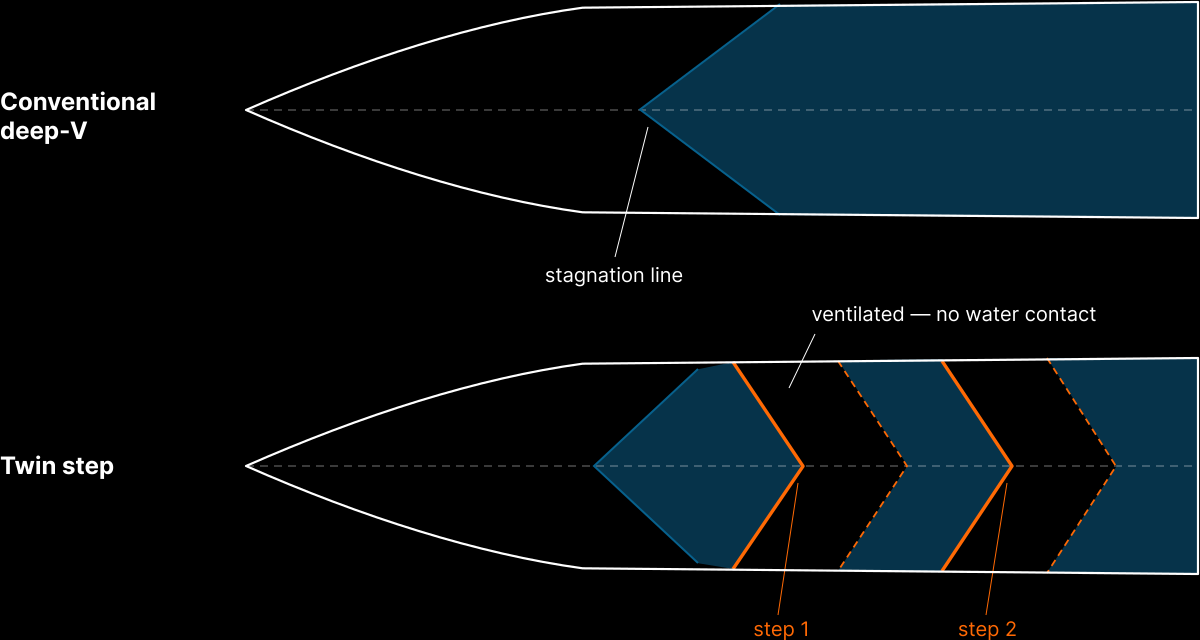
On a conventional planing hull the bottom is one continuous surface, running from the stagnation line aft to the transom. On a stepped hull that surface is interrupted. Aft of the step, the bottom sits above the projection of the surface forward of it.
At planing speed the flow separates cleanly at the step edge and cannot follow the surface as it retreats upward. A void opens behind the step and air fills it. Further aft the flow meets the hull again and reattaches. The result is two planing surfaces where there was one, with a ventilated gap between them. A twin-step hull gives three.
Why It Changes Anything
At high speed, frictional resistance is a large share of a planing hull's total drag, and frictional resistance scales with wetted area. Removing a strip of wetted surface removes drag in close to direct proportion.
Lift is redistributed across separate surfaces rather than carried on one long wetted triangle.
None of this happens below planing speed. A step only works once the flow is fast enough to separate and stay separated. Below that threshold it contributes nothing but an interruption in the bottom.
Ventilation Is The Mechanism
The cavity behind the step has to be fed with air, normally through the chines or through dedicated vents. This is not a refinement to be added later. It is the entire principle.
If air cannot reach the cavity, the void becomes a region of reduced pressure. Instead of lowering drag it pulls the hull down and raises resistance. Tank tests in which ventilation is deliberately blocked show exactly that. A step that does not ventilate is not a step.
Where The Difficulty Sits
Three variables govern the outcome: where the step falls along the length, how tall it is, and how it is swept across the bottom.
Position is set relative to the longitudinal centre of gravity, because the step decides how load is shared between the forward and after surfaces. Placed too far aft it reduces trim, increases wetted surface and raises resistance rather than lowering it. Height governs whether the cavity opens at all and how far aft the flow reattaches. Sweep influences how readily air reaches the cavity across the full beam.
The trade is sensitivity. Because a stepped hull carries its load on discrete surfaces, it responds more sharply to changes in trim and loading than a continuous deep-V does. Behaviour in turns, in a following sea and through the planing hump all have to be examined rather than assumed. The hull rewards being loaded the way it was drawn.
When It Is The Right Answer
Steps earn their place on craft that spend most of their operating hours at speed, where a reduction in wetted area compounds into range and fuel burn. They earn considerably less on craft that spend their time below planing speed, or where loading varies widely from one trip to the next.
That is a question about the operating profile, not about the hull form, and it is answered before the first line is drawn.